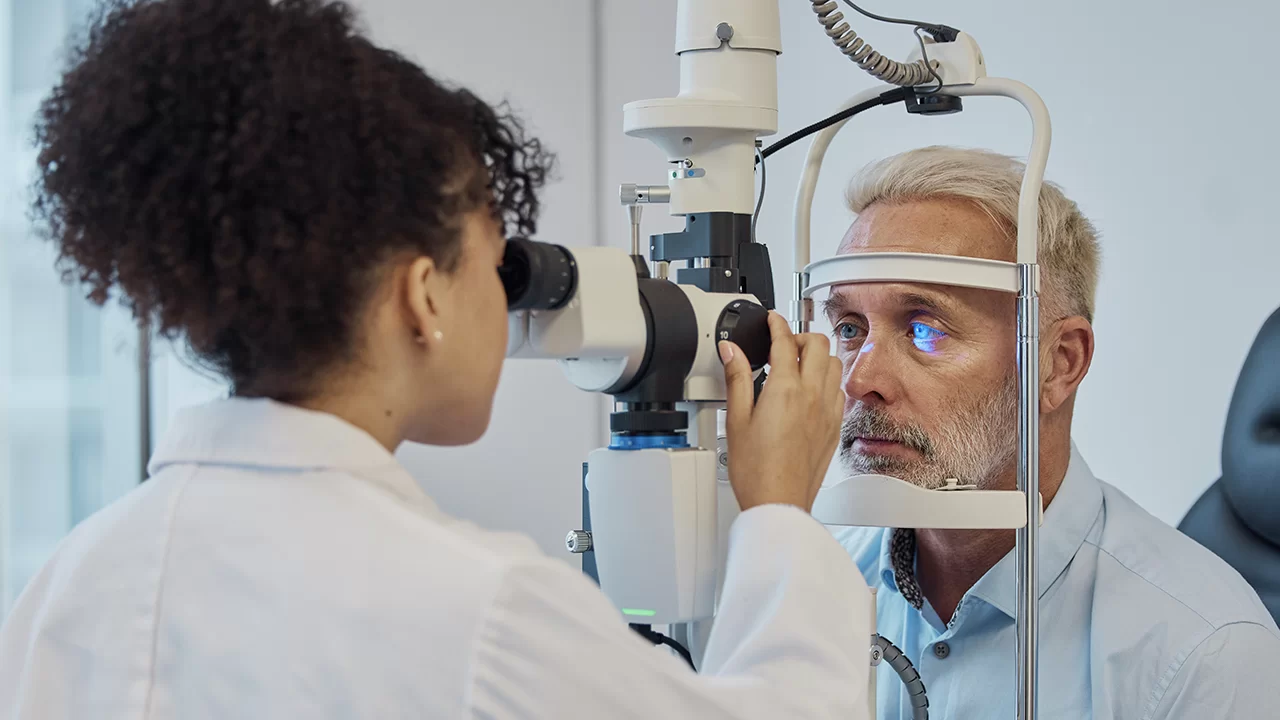
Today's fast-paced, competitive, and stress-oriented modern lifestyle affects our eye health as deeply as it affects many other systems in our body. Central Serous Retinopathy (CSR), which suddenly reduces the vision quality and disrupts the life comfort of young and middle-aged individuals working under intense stress, is an important alarm given by the body through the eyes against fatigue and tension.
What is Central Serous Retinal Retinopathy (CSR)?
The nerve layer covering the inner surface of our eye and initiating the vision process is called the retina. The most critical region of the retina is the macula (yellow spot), our sharp vision center responsible for functions such as reading, recognizing faces, and clearly distinguishing colors. Directly beneath the retina lies the "choroid" layer, a rich vascular network that nourishes the eye. Between the retina and the choroid, there is a special cell layer called the "Retinal Pigment Epithelium (RPE)," which acts as a barrier or filter.
Central Serous Retinopathy is a disease where this barrier (RPE) layer loses its sealing property for various reasons, and fluid from the underlying choroid layer leaks and accumulates under the retina. You can think of this situation as a water leak in a wall causing the wallpaper to bubble from underneath. This fluid accumulating under the macula pushes the anatomical structure of the retina upward, creating a kind of fluid-filled blister. As a result of the macula being lifted from its original place and the cells remaining within the fluid, an abrupt and significant distortion occurs in the patient's central vision.
What are the Causes and Risk Factors?
Although the exact cause of CSR has not been fully elucidated at the cellular level, clinical research clearly reveals that the disease is directly related to systemic stress factors and hormones. The most prominent risk factors are:
- Stress and Type A Personality: The strongest trigger of the disease is intense physical and psychological stress. It is much more common in individuals who are perfectionistic, competitive, racing against time, impatient, and highly stressed (Type A personality). It is thought that high cortisol and adrenaline levels secreted during stress disrupt vascular permeability behind the eye.
- Corticosteroid Use: The risk of the disease increases exponentially in people using cortisone medications, creams, nasal sprays, or intra-articular injections for any health problem (rheumatism, asthma, allergy, skin diseases, or joint pain). Cortisone prepares the ground for fluid leakage by changing the structure of blood vessels.
- Gender and Age: The disease generally affects young and middle-aged adults between the ages of 20 and 50. The incidence in men is 6 to 10 times higher than in women.
- Sleep Apnea: In patients with severe snoring and sleep apnea syndrome, oxygen drops during the night increase the risk of CSR.
- Pregnancy: Intense hormonal fluctuations during pregnancy can cause this disease to appear in women, albeit rarely.
What are the Symptoms of Central Serous Retinopathy?
The disease usually starts suddenly and in one eye. Vision loss is never in the form of total blindness, but it seriously impairs central vision quality. Patients generally apply to our clinic with the following specific complaints:
- Blurred Central Vision: Formation of a hazy, smoky, or dark fixed spot (scotoma) in the center of the focus point.
- Micropsia (Seeing Smaller): Because the distance between retinal cells increases due to the fluid under the macula, objects are perceived as smaller or further away when viewed with the affected eye compared to the other eye.
- Distorted and Curved Vision (Metamorphopsia): Straight lines, such as door frames or tile lines, appearing wavy, tilted, or distorted.
- Changes in Color Perception: Colors not appearing as vivid as before, especially white surfaces being perceived as more yellowish, pale, or brownish.
- Loss of Depth Perception: Weakening of depth perception and 3D vision due to the vision difference between the two eyes.
Advanced Diagnostic Methods for Definitive Diagnosis
The diagnosis of CSR is made not only by listening to patient complaints but also with our high-tech devices that can detect millimetric fluid leaks:
- Optical Coherence Tomography (OCT): Our device that takes 3D, radiation-free cross-sectional images of the retina and macula in seconds. The amount, height, and spread of fluid accumulating under the retina are clearly visualized at the micron level. It is the gold standard in diagnosis and follow-up.
- Fluorescein Angiography (FFA): A critical test to find the source of the disease. By injecting a harmless fluorescent dye through a vein in the arm, the vessels behind the eye are monitored. The exact point where the dye leaks under the retina (appearing as a "smokestack" or "ink blot") is fully mapped.
- Indocyanine Green Angiography (ICGA): Used in chronic or resistant cases to examine the condition of the choroidal vascular network and hidden leaks deeper under the retina.
Treatment Methods: Personalized Approaches
The approach in CSR treatment is shaped specifically for the patient by Dr. Ayşe Öner according to the duration of the disease (acute or chronic) and how much the patient's daily life is affected.
1. Observation and Waiting (Acute Phase Treatment)
In a large majority of patients (approximately 80-90%), the fluid under the macula is spontaneously absorbed by the body within 3 to 4 months, and the disease heals without requiring any medical intervention. During this waiting period, patients are advised on stress management, maintaining sleep patterns, and gradually tapering off cortisone medications (in consultation with the relevant doctor). The absorption rate of the fluid is closely monitored with regular OCT scans.
2. Photodynamic Therapy (Cold Laser - PDT)
If the fluid is not absorbed for longer than 3-4 months (becoming chronic) or if the disease recurs frequently, the fluid can cause permanent damage to retinal cells. In this case, the most effective method is Photodynamic Therapy (PDT). A light-sensitive drug is injected through a vein, which reaches the leaking vessels behind the eye. Then, a low-energy "cold laser" is applied to the leak area, activating the drug and closing the leak without causing cellular damage. Unlike standard lasers, it is an extremely reliable method that does not cause burns or damage to the macular tissue.
3. Micropulse Laser Therapy
Unlike standard thermal (burning) laser, this involves sending low-energy laser to the target tissue in small pulses lasting microseconds instead of continuously. It accelerates the absorption of fluid by stimulating RPE cells and does not damage healthy tissues.
Do not let the blurriness and distortions in your central vision overshadow the true colors of life and your achievements. To regain your health with both a stress-free environment and the world's most advanced retinal treatment technologies, contact our patient coordinators immediately.
Frequently asked questions
CSR occurs when fluid leaking from the vascular layer under the visual center (macula) creates a water bubble (edema) under the retina. Patients see a blurry, dark, or pale-colored spot directly in front of them. It is scientifically directly linked to high levels of the stress hormone (Cortisol). Therefore, it is more common in young to middle-aged men who experience intense work stress, have perfectionist (Type A personality) traits, or suffer from insomnia.
A large portion of CSR cases may resolve spontaneously within 3-4 months when the stress factor is removed. However, if the fluid is not absorbed during this time, the disease turns into "Chronic CSR." If water remains under the retina for a long time, it causes permanent blindness by decaying the vision cells. Therefore, it should never be "left to chance," and the status of the fluid should be closely monitored monthly with our dropless OCT mapping systems.
Yes, this is exactly why we use much safer and innovative technologies instead of burning thermal lasers in CSR treatment. With targeted Micropulse (Cold) Laser therapy, we stimulate only the leaking cells to encourage fluid absorption without burning the sensitive photoreceptors in your macula. For our international patients, you can safely return to your country by plane after this needle-free and painless procedure, which is applied with zero waiting time.